Ācārāṅga Sūtra
The oldest Aṅga: how to live without harming any living being — and Mahāvīra’s own fearless ascetic journey.
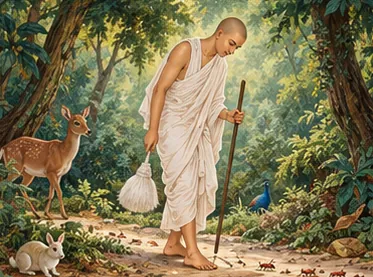
Ācāra means conduct — the way you walk, eat, speak and live. Aṅga means limb. This is the first limb of the body of Jain scripture, and many scholars regard its first part as among the very oldest Jain writing.
Its heartbeat is one idea: every living being wants to live. None wants pain. So live in a way that wounds as little as possible.
The story
“Who Am I?”
The book begins not with a rule, but with a question. Some people do not know where they came from, or where they will go. Am I a soul that continues? What am I doing here?
The Ācārāṅga answers: you are a soul — and so is the earth beneath your feet, the water you drink, the fire you light, the wind, the plants, and every creature that moves.
This is the teaching of the six kinds of living beings. It turns the whole world into a place full of life — and makes every action a moral choice.
All Beings Love Life
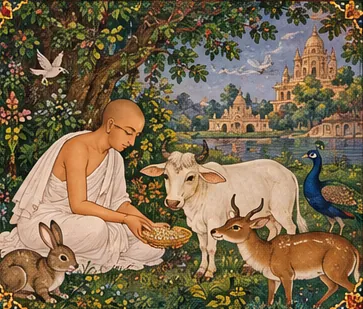
The text says it plainly: all beings are fond of life. They like pleasure and dislike pain. They shrink from destruction and long to live.
Then comes one of its most powerful thoughts. The one you intend to strike is none other than yourself. The one you intend to rule over is none other than yourself.
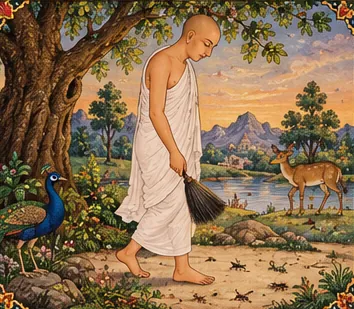
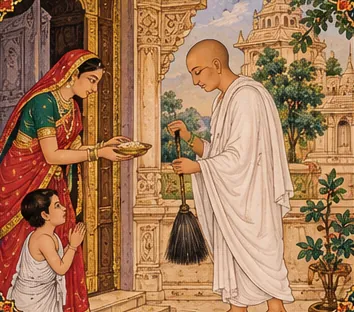
That is why the monk walks with a soft broom, sweeping gently ahead so that no tiny creature is crushed. Non-violence is not a slogan here; it is a way of putting your foot down.
The Prince Who Walked Away
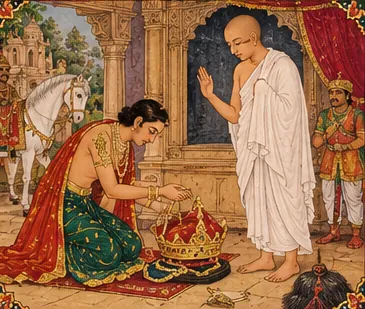
The ninth chapter, the Upadhāna-śruta, tells a true adventure. Prince Vardhamāna leaves his palace, his family and his wealth, and walks into the world with nothing.
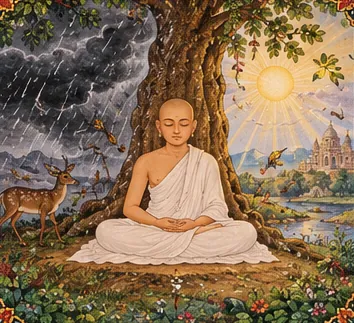
For more than twelve years he wanders. He meditates in empty houses, cremation grounds and under trees. He eats what is offered, often fasting for long periods. He speaks very little.
The text describes him with a single, unforgettable image: like an elephant at the head of battle, he did not turn back.
The Land Where Dogs Were Set Upon Him
In the rough country of Lāḍha, the text recalls, people struck him, threw dust on him and set dogs to bite him. Few would give him food.
Mahāvīra did not curse them. He did not run. He did not even scratch his body. He bore cold winds in winter and burning sun in summer, steady as a mountain.
This is not cruelty to the self for its own sake. It is the training of a mind so calm that nothing outside can push it into anger or fear.
The Second Book: Daily Life
The second part of the Ācārāṅga turns from the hero’s journey to everyday details — because for Jains, spiritual life is lived in details.
How should a monk ask for food without causing a family to cook especially for him? Where may he stay? How should he walk on a road wet with rain? How should he speak — truthfully, gently, without harsh words?
It ends with the five great vows and their supporting practices: a complete design for a life of harmlessness.

The Fruit of Awareness
The Ācārāṅga says that one who knows one thing truly knows everything — and one who knows everything knows that one thing. Know your own soul deeply, and you understand the world.
The journey of Vardhamāna ends in kevala-jñāna, perfect knowledge, under a śāla tree near the Ṛjuvālikā river.
The first Aṅga places that sunrise at the end of a long, patient road of awareness — open, it insists, to anyone willing to walk carefully.
What it teaches
- All six kinds of beings — earth, water, fire, air, plants and moving creatures — have life
- Harming another is, in a deep sense, harming yourself
- Mahāvīra’s twelve-year ascetic life is the model of endurance
- Spiritual life is lived through daily details: walking, eating, speaking
- The five great vows complete the design of a harmless life
How the text is arranged
Two books (śrutaskandhas). The first has nine chapters on inner discipline, ending with the Upadhāna-śruta on Mahāvīra’s austerities; its seventh chapter is traditionally said to be lost. The second book, in sections called cūlās, deals with alms, lodging, walking, speech, clothing and bowls, and closes with the five great vows.
Walk gently. The ground is alive.
Ask yourselfWhere in your day could a little more care spare another being from harm?