Sūtrakṛtāṅga
A great debate of ideas — and the famous parable of the white lotus that no clever man could reach.
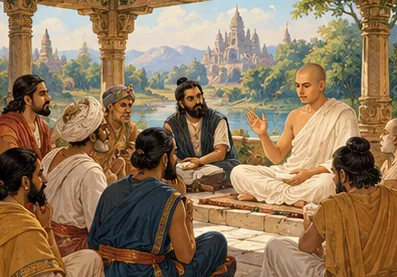
Sūtra-kṛta can be read as “what is set down in sūtras” or “the making of doctrine.” It is the second Aṅga.
In Mahāvīra’s India, the marketplace of ideas was crowded. Some teachers said the soul does not exist. Some said everything is fixed by fate. Some said ritual alone saves. This book walks through those views and tests each one.
The story
A Crowded Marketplace of Ideas
Tradition counts 363 views circulating in that age — believers in action, deniers of action, sceptics who said nothing can be known, and those who said humility alone is enough.
The Sūtrakṛtāṅga listens to them, then asks a hard question: does this view help a person stop causing harm and become free? If a view excuses violence, or leaves you careless about your actions, it is a trap — however clever it sounds.
The Danger of Half-Truths
Many of these views are not simply foolish. Each grabs one part of reality and calls it the whole.
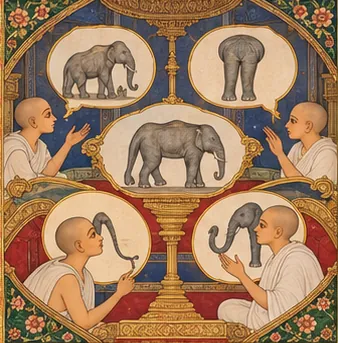
Later Jain teachers would illustrate this with the well-known image of blind people touching an elephant: one feels a trunk and says “snake,” another a leg and says “pillar.” Each is partly right, and wrong to deny the rest.
The Sūtrakṛtāṅga plants the seed of that thinking: look at reality from many angles before you claim the whole truth.
The Parable of the White Lotus
The second book opens with one of the most beautiful stories in Jain literature.
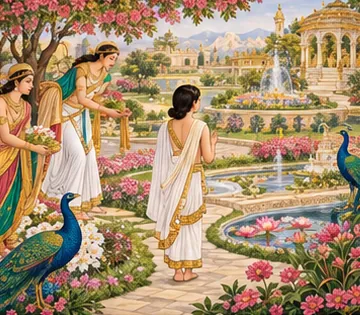
There is a great lotus pond, deep with water and thick with mud. In the very centre blooms one magnificent white lotus. A man comes from the east and says, “I am clever; I will pluck it.” He wades in — and sinks into the mud. A man from the south tries, then the west, then the north. All four are stuck.
Then a monk arrives on the bank. He does not enter the water. He simply calls: “Rise up, O white lotus!” And the lotus rises and comes to him.
What the Lotus Means
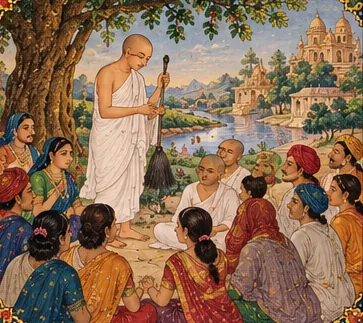
Mahāvīra explains the parable. The pond is the world. The water is karma; the mud is desire and pleasure. The white lotus is a soul ready for liberation. The four men are four kinds of teachers whose methods leave them trapped in the very world they claim to master.
The monk on the bank is the one who has stepped out of the mud. Because he is free, his word has the power to lift others.
You cannot pull anyone out of a swamp while you are still sinking in it.
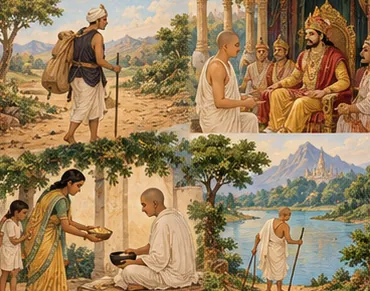
Ārdraka Meets the Debaters
Another chapter follows Ārdraka, a prince on his way to Mahāvīra. On the road, one teacher after another stops him: an Ājīvika, Buddhists, Vedic priests, and ascetics who believed it was better to kill one elephant a year than many small creatures.
Ārdraka answers each with calm reasoning. To the elephant-killers he points out that a life is a life — and a path built on killing cannot be a path of compassion.
He walks on, mind clear, to the feet of Mahāvīra.
What it teaches
- Not every attractive idea leads to freedom
- A view that excuses harm is a trap
- Truth has many sides; do not mistake a part for the whole
- Only a person free of desire can truly lift others
- Reasoned debate is part of the spiritual path
How the text is arranged
Two books. The first, mostly in verse, has sixteen chapters on rival views, the hardships of monks and the nature of the true ascetic. The second, largely prose, has seven chapters, including the Puṇḍarīka (white lotus), Ārdraka and Nālandā chapters.
A clever mind can still be stuck in the mud. A free mind calls the lotus home.
Ask yourselfWhich of your firm opinions might be one side of a larger truth?