Aupapātika Sūtra
A king’s grand procession to hear Mahāvīra — and the questions of where souls are reborn.
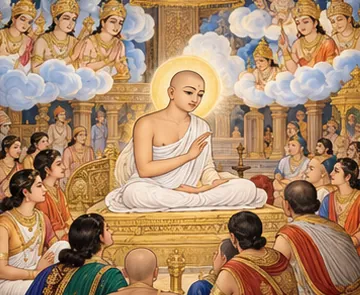
Upapāta means birth, especially rebirth in other realms. This first Upāṅga begins with one of the most splendid descriptions in Jain literature — a city, a garden and a king going to meet the Master — and ends with deep questions about where souls go after death.
The story
A Messenger Runs to the King
The city is Campā, rich and beautiful, with its walls, gates and markets. Outside the city lies a garden shrine called Pūrṇabhadra.
One morning, a messenger rushes to King Kūṇika: Mahāvīra has arrived in the garden! The king leaps from his throne, takes seven steps toward the direction of the Master and bows to the ground. He rewards the messenger richly.
Then he orders: prepare the elephants, the chariots, the whole city — we are going to hear him.
The Procession
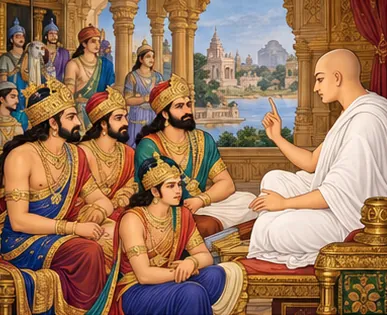
The text describes the procession in rich detail: decorated elephants, soldiers, umbrellas and fans, crowds of citizens in their finest clothes.
When the king sees the Master from afar, he gets down from his elephant. He lays aside his royal symbols — sword, umbrella, crown — and approaches on foot, with folded hands.
Power bows before peace.
The Portrait of the Master
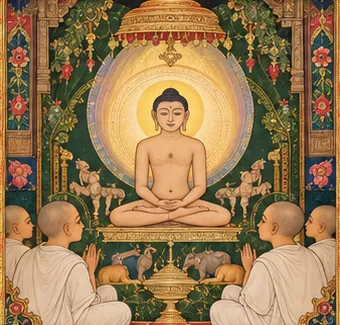
The Aupapātika offers one of the most complete classical portraits of Mahāvīra, from head to foot, along with descriptions of his monks: their learning, austerities and forms of meditation.
Then comes his sermon: on the soul, karma, the vows of monks and householders, and the path to liberation.
Many later texts simply say “as described in the Aupapātika” — this book became the model for describing assemblies.
Where Do Souls Go?
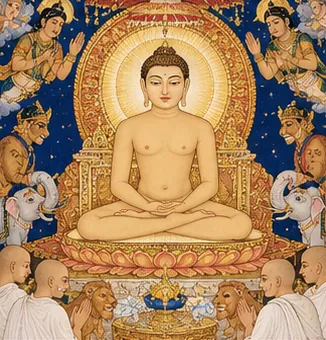
In the second part, Gautama asks about rebirth. What becomes of those who suffer without understanding? Of ascetics of other paths? Of the wandering teacher Ambaḍa and his disciples?
The answers map the journeys of souls into many kinds of rebirth — and finally describe the Siddhas, the liberated souls who are never born again.
What it teaches
- A king lays aside power to approach the Master
- The text gives a model description of a teaching assembly
- Different lives lead to different rebirths
- Liberation is the end of all rebirth
How the text is arranged
Two parts: the Samavasaraṇa (assembly) section, describing Campā, King Kūṇika’s visit and Mahāvīra’s sermon; and the Upapāta section, Gautama’s questions on rebirth, ending with the liberated Siddhas. Traditionally linked to the Ācārāṅga.
The greatest king in the story is the one who walks barefoot to listen.
Ask yourselfWhat “crown” would you need to set down to truly listen?