Daśavaikālika Sūtra
A father’s gift to a son with six months to live: the essentials of the path, in ten chapters.
Daśa means ten; vaikālika can mean “composed at an unusual time” — in the evening. Every new Jain monk and nun studies it. It is perhaps the most practically important text for monastic life.
The story
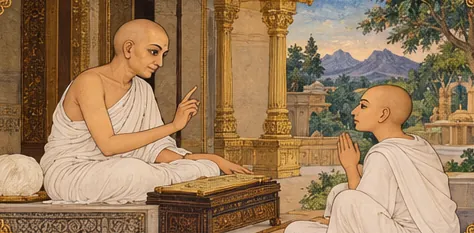
The Father and the Son
Śayyambhava was a brahmin who left home to become a Jain monk while his wife was expecting a child. Years later, a boy named Manaka came searching for his father — and found him, now a great teacher.
Śayyambhava recognised his son, but did not reveal it. He took Manaka as a disciple. Through his insight, the teacher saw that the boy had only six months to live.
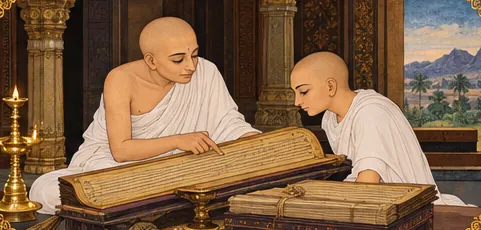
A Book in Six Months
How could a child learn the whole vast scripture in six months? He couldn’t. So the teacher drew out the essentials and composed them into ten chapters — the Daśavaikālika.
Manaka studied them devotedly. When he died, Śayyambhava wept. Only then did the other monks learn that the boy had been his son.
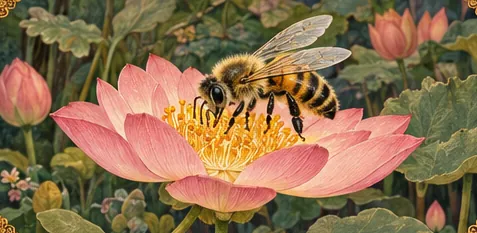
The Bee and the Flower
The very first chapter begins: Dharma is the highest auspiciousness — non-violence, restraint and austerity.
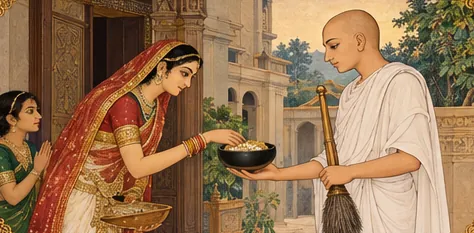
Then comes a famous image: as a bee takes a little nectar from many flowers without harming any, so a monk takes a little food from many homes without burdening any.
This is why Jain alms-rounds are sometimes called “the bee’s way” (madhukarī).
Ten Chapters for Life
The chapters cover the six kinds of living beings, how to seek alms, how to speak (truthfully, gently, without harmful words), humility before teachers, and finally: who is a true monk?
To this day, new monks and nuns begin their monastic life with this book — a father’s gift, still given to every new child of the path.
What it teaches
- Dharma is non-violence, restraint and austerity
- Take from the world like a bee — lightly and harmlessly
- Speech must be true, kind and careful
- Every new monk studies this text
How the text is arranged
Ten chapters plus two appendices (cūlikās). Composed, according to tradition, by Śayyambhava for his son Manaka.
Take from the world as a bee takes from a flower: a little, from many, harming none.
Ask yourselfIf you had six months to learn what matters, what would you study?