Uttarādhyayana Sūtra
Thirty-six lessons traditionally linked to Mahāvīra’s final teaching — full of unforgettable stories.
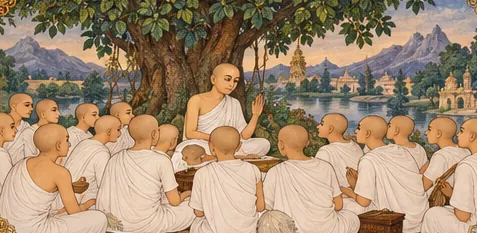
Uttara can mean “later” or “excellent”; adhyayana means lessons. Many Jains hold that these thirty-six chapters were among Mahāvīra’s final teachings before his nirvāṇa. It is one of the most loved Jain texts.
The story
A Pale Leaf Falls
In one chapter, Mahāvīra speaks to Gautama: as a pale leaf falls from a tree when its time comes, so does a human life end.
Life is like a dewdrop on the tip of a blade of grass. So, Gautama — do not be careless, even for a moment.
That refrain, repeated again and again, is one of the most quoted lines in Jain tradition.
King Nami and the Silent Bangle
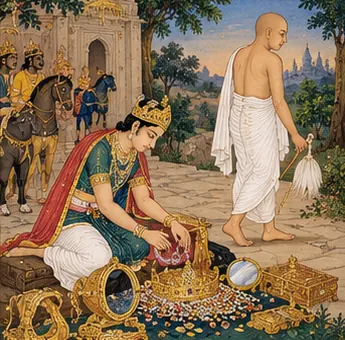
King Nami fell ill with a burning fever. His queens ground sandalwood to cool him, and the jingling of their many bangles made his head ache. They removed all but one bangle each — and the noise stopped.
Nami realised: one bangle makes no sound. Many make noise. So it is with the soul — alone, it is at peace. He renounced his kingdom. When the god Indra came disguised to test him, Nami answered every argument with calm wisdom.
Rājīmatī in the Cave
On his wedding day, prince Ariṣṭanemi heard animals crying in pens, kept to be killed for the feast. He turned his chariot around and became a monk. His bride, Rājīmatī, later became a nun.
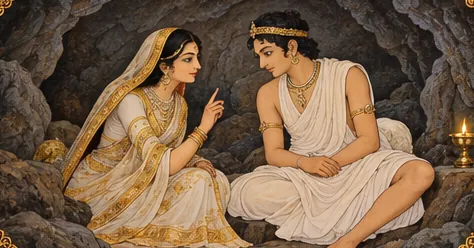
Once, caught in rain, she took shelter in a cave to dry her clothes, not knowing that Ariṣṭanemi’s brother Rathanemi, a monk, was already inside. He was overcome by desire.
Rājīmatī, calm and fearless, spoke to him so powerfully that he recovered himself — like an elephant brought back by the goad.
Two Traditions Meet
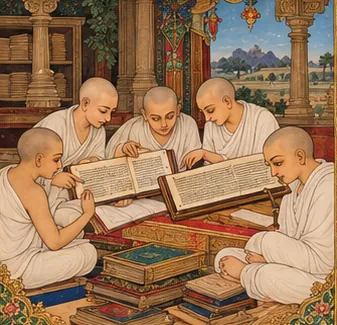
Another chapter tells how Keśī, of Pārśvanātha’s tradition, and Gautama, of Mahāvīra’s, met at Śrāvastī. Their followers wondered: why do our teachers differ — four vows or five? Clothes or few clothes?
The two leaders met with respect, asked and answered. They found that their goal was the same. Keśī joined Mahāvīra’s order.
It is a beautiful model of dialogue: two leaders, no anger, one truth.

Four Rare Things
One lesson names four rare things: being born human, hearing the teaching, having faith in it, and putting effort into restraint.
If you have the first three, the Uttarādhyayana says, do not waste the fourth.
What it teaches
- Do not be careless, even for a moment
- Peace grows in solitude, like a single silent bangle
- Courage and wisdom can rescue another from desire
- Dialogue between traditions can find common truth
- Human life and the chance to practise are rare
How the text is arranged
Thirty-six chapters in verse and prose, including Vinaya, the four rare things, Nami’s renunciation, the falling leaf, Harikeśa, Rathanemi, Keśī–Gautama, and the analysis of living and non-living beings.
Life is a dewdrop on a blade of grass. Do not be careless, even for a moment.
Ask yourselfWhat is the one bangle you would keep if you took off all the others?