Jīvājīvābhigama
A grand map of all beings — from a single-sensed seed to humans and gods — and the world they live in.
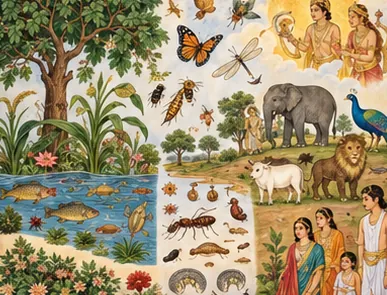
Jīva means living soul; ajīva means non-living reality. Abhigama means understanding. This text asks you to see the world as a Jain does — as a vast family of living beings, each with a soul.
The story
One-Sensed to Five-Sensed
Jain thought classifies beings by their senses. Earth, water, fire, air and plants have only touch. Worms add taste. Ants add smell. Bees and flies add sight. Animals, humans, gods and hell-beings have all five — and some have mind.
The Jīvājīvābhigama takes this map and fills it in, chapter by chapter.
Nine Ways of Counting
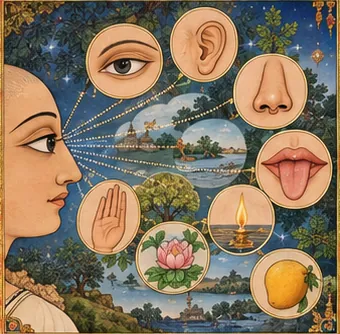
The text arranges worldly beings in nine different groupings — as two kinds, three kinds, four, and so on to ten. Each way of counting reveals something new: by movement, by gender, by sense, by realm.
It is like turning a crystal in the light. The same world, seen from many angles, shows new colours.
Islands and Oceans
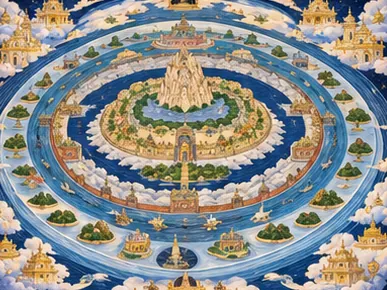
The book then turns to the world itself — the rings of continents and oceans in Jain cosmology, beginning with Jambūdvīpa at the centre.
These descriptions belong to traditional cosmology, not modern geography. But they share a powerful idea: wherever you go in the universe, you are surrounded by life.
Why Count Living Beings?
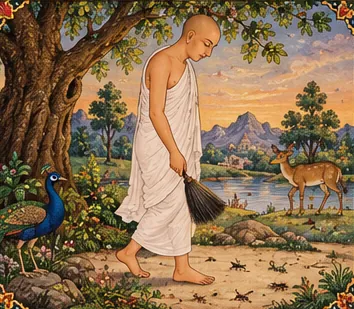
Why would a spiritual text spend so long classifying beings? Because you cannot avoid harming what you cannot see.
The Jain care for life — filtering water, eating before sunset, sweeping the path — grows from knowledge like this. Understanding becomes compassion.
What it teaches
- All reality is living (jīva) or non-living (ajīva)
- Beings are classified by their senses
- The same world can be counted in many ways
- Knowledge of life supports non-violence
How the text is arranged
Organised in nine sections (pratipattis), each dividing worldly beings in a different way, with long descriptions of cosmology. Its categories belong to Jain philosophy, not modern biology.
Learn to see life everywhere, and you will learn to step gently everywhere.
Ask yourselfHow many living beings did you meet today without noticing them?