Prajñāpanā Sūtra
Thirty-six chapters that organise the Jain universe — composed by the teacher Ārya Śyāma.
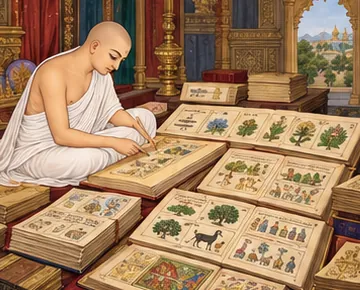
Prajñāpanā means “making known” or “exposition.” Unlike most Āgamas, its author is named: tradition attributes it to Ārya Śyāma. It is a vast reference work, the largest of the Upāṅgas.
The story
A Catalogue of Existence
The Prajñāpanā has thirty-six chapters called padas. Each takes one subject — living beings, places, lifespans, senses, karma, colours of the soul (leśyā), language, bodies — and explains it in detail.
It answers questions like: where do different beings live? How long? In what numbers? How do they breathe, perceive, speak?
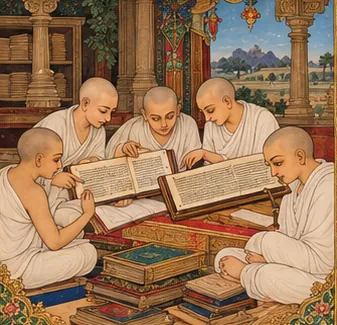
The Six Colours of the Soul
One fascinating chapter describes leśyā — the “colours” of a soul’s inner disposition, from black (cruel) to white (pure).
A famous illustration: six travellers see a fruit-laden tree. One wants to cut it down; one, to break a branch; one, a twig; one, to pluck fruit; one, to take what is ripe; the last only picks up fruit that has fallen.
Same tree, six minds, six colours.
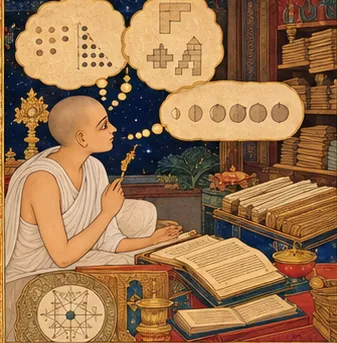
Relative Numbers
Another chapter compares the numbers of different kinds of beings: which are more, which are fewer. Liberated souls are infinite, yet the beings still in the cycle are infinitely more.
This is not dry counting. It is a reminder of how rare human birth is — and how precious a chance it is to walk the path.
What it teaches
- Knowledge of reality is organised into 36 topics
- The soul’s inner disposition has “colours”
- Human birth is rare among countless beings
- This is one of the few Āgamas with a named author
How the text is arranged
Thirty-six padas (chapters) covering beings, places, numbers, lifespans, senses, karma, leśyā, language and more. A key source for later Jain philosophy.
The same tree can draw six different hands. Notice which hand is yours.
Ask yourselfWhat colour was your mind the last time you wanted something?