Anuttaraupapātikadaśāṅga
Dhanya, whose austerity was praised as the greatest among 14,000 monks — and why heaven is still not the goal.
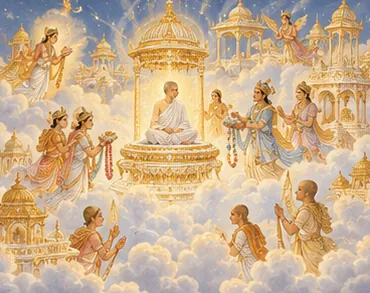
Anuttara means “unsurpassed.” Upapāta means birth, especially in the heavens. These are souls reborn in the five highest heavenly realms of Jain cosmology.
They are almost free — the tradition says they will be liberated after one more human birth. Their stories stand between earthly life and final freedom.
The story
The Top of the Heavens
Jain cosmology describes many heavens, stacked one above another. At the very top lie the five anuttara realms, the highest, among them Sarvārthasiddha — “where every aim is fulfilled.”
Beings there live in deep peace, with little desire. And yet even they are still in saṃsāra, the cycle of birth and death.
This book tells of 33 people who reached those heights — princes of Śreṇika’s family, and a merchant’s son named Dhanya.
Dhanya of Kākandī
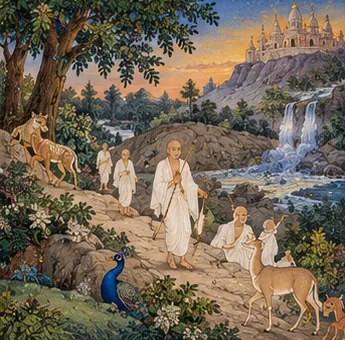
Dhanya was the son of a rich widow, raised in luxury. After hearing Mahāvīra, he took initiation and made a fierce vow: he would fast, and when he broke the fast, he would eat only the plainest dry food.
The text describes his body with an unforgettable chain of images — limbs like dried twigs, ribs like a row of beads, a face like a withered lotus.
But his spirit, it says, shone like fire hidden under ash.
The Greatest of Fourteen Thousand
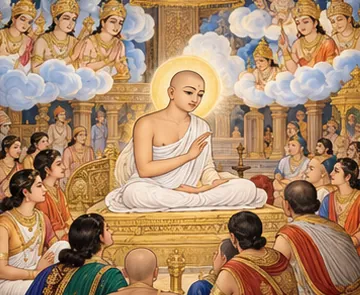
One day King Śreṇika asked Mahāvīra, “Among your fourteen thousand monks, who is the greatest practitioner?”
Mahāvīra did not name a famous scholar or a royal prince. He named Dhanya.
Śreṇika went to Dhanya and bowed to him. Dhanya was reborn in Sarvārthasiddha, the highest heaven — and the tradition holds that he will reach liberation after one more human life.
Why Heaven Is Not the Goal
Why does a scripture tell stories that end in heaven, not in liberation?
Because it wants us to see clearly. Heaven is a reward, but rewards end. Only the soul’s freedom is permanent.
These lives show the highest point of the ladder of rebirth — and quietly remind us that the goal is to step off the ladder altogether.
What it teaches
- The highest heavens are still within the cycle of rebirth
- Inner strength can shine through outer frailty
- True greatness is measured by inner discipline, not status
- Heaven is a stage, not the final goal
How the text is arranged
Three sections (vargas) containing 33 short accounts. The first two sections are mostly princes of King Śreṇika’s family; the third tells of Dhanya and others. Descriptive passages are traditionally given in abbreviated form, referring to other texts.
Even the highest palace is still a house. Liberation is home.
Ask yourselfWhat rewards do you chase that might still keep you on the ladder?