Bhagavatī Sūtra
Thousands of questions from Gautama — and dramatic stories of a rebel son-in-law and a rival who unleashed fire.
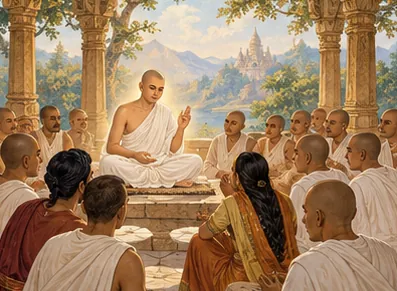
Vyākhyā-prajñapti means “the setting forth of explanations.” It is so honoured that it is lovingly called the Bhagavatī — “the blessed one.” It is the largest of the Aṅgas.
At its heart is a teacher and a student: Mahāvīra and his first disciple Gautama, whose questions never end.
The story
The Questioner
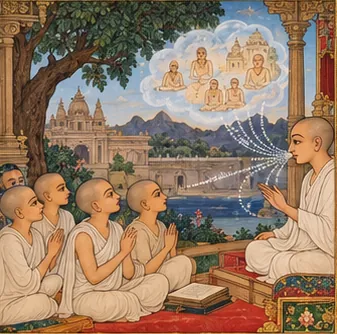
Gautama was a learned brahmin, proud of his knowledge, who came to Mahāvīra to argue — and stayed to learn. Now he is the greatest questioner in Jain literature.
Is the world finite or endless? Is the soul the same as the body? How does karma stick to a soul? Can the dead be heard? Tradition counts some 36,000 questions in this book.
Each begins with Gautama bowing and asking. Each ends with the Master’s patient answer.
A Universe Seen from Four Sides
A wandering ascetic named Skandaka once came with five difficult questions, including: is the world finite or infinite?
Mahāvīra’s answer is a model of Jain thinking. As a substance, the world is one and finite. In space, it has limits. In time, it has no beginning and no end. In its changing forms, it is endless.
One question, four viewpoints, four honest answers. Skandaka was so moved that he took initiation.
Jayantī’s Bold Question
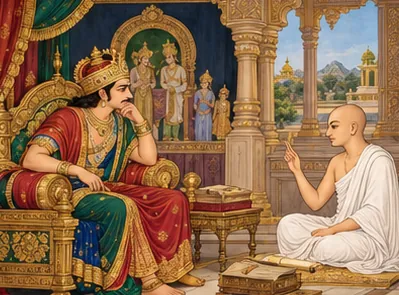
Not only men ask questions here. Jayantī, a royal lady of Kauśāmbī, asks Mahāvīra something that sounds almost like a riddle: is it better to be asleep or awake?
His answer: for those who harm others, it is better that they sleep — they do less damage. For those who do good, it is better that they are awake.
Jayantī went on to renounce the world. Her questions remain, sharp and fresh, in one of the oldest dialogue-books in India.
The Rebel: Jamāli
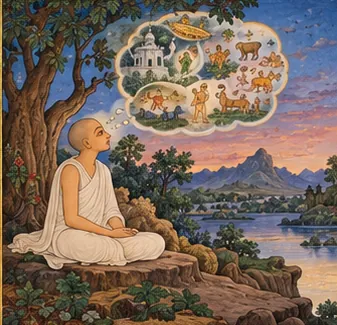
Not every story here is gentle. Jamāli, said in Śvetāmbara tradition to be Mahāvīra’s own son-in-law, became a monk and later disagreed with his teacher.
Lying ill, he asked monks to spread a bed. “Is it done?” “It is being done.” Jamāli declared that something being done is not yet done — challenging Mahāvīra’s teaching that what is being done is, in a sense, already done.
He left with followers, the first recorded split in the community.
The Rival and the Fire
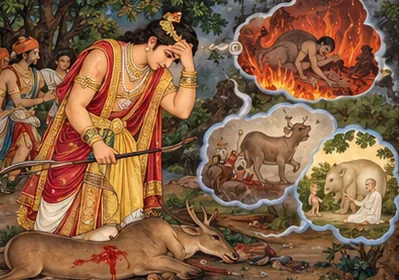
The most dramatic chapter tells of Gośāla Maṅkhaliputra, once Mahāvīra’s companion, later the leader of the Ājīvikas, who believed all events are fixed by destiny.
In a fit of anger at Sāvatthī, the text says, Gośāla released a fiery power. Two of Mahāvīra’s disciples died, and Mahāvīra himself fell ill for six months.
Yet the story ends in repentance. On his deathbed, Gośāla admitted his wrongs. Even the fiercest rival is shown as a soul capable of turning back.
The Sea of Answers
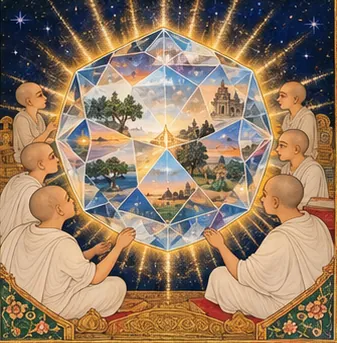
The Bhagavatī is not a book you finish in a day. It is a sea. You swim a little, find a pearl — a teaching on atoms, a vision of heaven, a moment of human drama — and return another day.
For scholars, it is a goldmine of ancient Indian history: other teachers, cities, kings and debates appear in its pages.
For seekers, it is a reminder that faith and questions are not enemies. Gautama, the greatest disciple, never stopped asking.
What it teaches
- Asking questions is part of the spiritual path
- Reality can be seen through substance, space, time and form
- The soul, karma, matter and cosmos are all examined
- Dissent and conflict are recorded honestly
- Even a fierce rival can repent
How the text is arranged
A vast text of 41 major sections (śatakas), with many sub-sections. Most passages are questions from Gautama or others, answered by Mahāvīra. It also contains biographical narratives such as those of Jamāli and Gośāla.
Ask, and keep asking. The greatest disciple was the one with the most questions.
Ask yourselfWhat is the one question about life you would bring to a wise teacher today?