Samavāyāṅga
Counting beyond ten — to hundreds, to the 63 great figures, and to a map of all twelve Aṅgas.
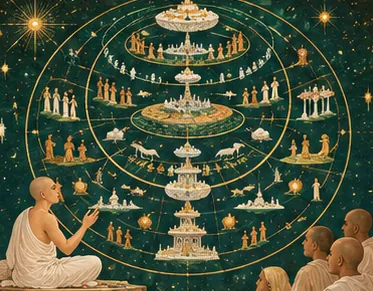
Samavāya means “coming together” or “collection.” This fourth Aṅga continues the numerical method of the Sthānāṅga, but carries it much further — to hundreds, thousands and the immense numbers of Jain cosmology.
It is also where we find a description of the whole set of twelve Aṅgas, like a table of contents for the entire scripture.
The story
Counting the Cosmos
Jain cosmology is vast. The universe is shaped somewhat like a standing person, with hells below, the middle world in the centre and heavens above. Time moves in great cycles of rising and falling ages.
To describe all this, the Samavāyāṅga uses numbers like steps on a ladder. Each step holds facts: the lifespans of beings in different realms, the heights of mountains, the numbers of disciples of great teachers.
Climbing these numbers, the reader begins to sense how small one life is — and how precious.
The Sixty-Three Great Souls
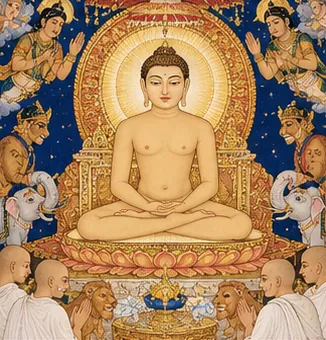
One of its most important lists is of the 63 “illustrious persons” (śalākā-puruṣas) of our age: 24 Tīrthaṅkaras, 12 Cakravartins (world emperors), 9 Baladevas, 9 Vāsudevas and 9 Prativāsudevas.
These figures would later become the heroes of great Jain epics. Here, in compact lists, we meet them first: their names, their parents, their cities, their lifespans.
Like seeds in a packet, each name holds a whole story waiting to grow.
A Map of the Whole Scripture
The Samavāyāṅga also describes the twelve Aṅgas themselves — what each one contains and how long it is.
This is precious for historians. It shows how the tradition understood its own scriptures, including the lost twelfth Aṅga, the Dṛṣṭivāda, and how some texts, like the Praśnavyākaraṇa, may have changed over time.
Reading it is like finding an old library catalogue: it tells you not only what is on the shelves, but what once was.
What it teaches
- Numerical groupings continue far beyond ten
- The 63 great figures of the present age are listed
- Cosmological measurements show the vastness of the universe
- The text describes the contents of all twelve Aṅgas
- It helps historians trace how the canon changed
How the text is arranged
Organised by number, from one upward to a hundred and then to very large numbers, followed by sections describing the twelve Aṅgas and lists of the illustrious persons. Best read together with the Sthānāṅga.
Even an endless universe can be studied one number at a time.
Ask yourselfIf a single human life is one tiny number in this vast count, how will you use yours?