Jñātādharmakathāṅga
An elephant who held up his foot for a tiny hare, two tortoises, and a wise bride with five grains of rice.
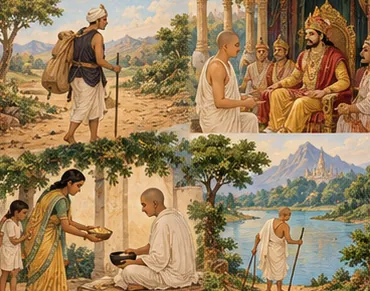
Jñāta means “example” or “known illustration,” and dharma-kathā means “religious story.” This is the great story-book of the Aṅgas.
Its tales are simple enough for a child to remember and deep enough for a monk to meditate on for a lifetime.
The story
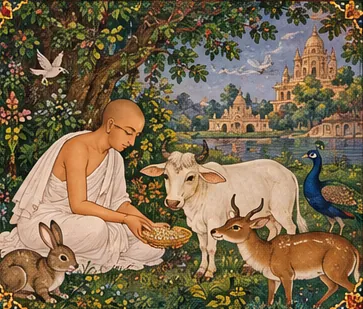
The Prince Who Wanted to Go Home
Prince Meghakumāra, son of King Śreṇika, became a monk. On his first night, he was given the sleeping place by the door. All night long, monks stepped past him, their feet brushing him, dust falling on him. He did not sleep.
At dawn he went to Mahāvīra, ready to return to the palace.
Mahāvīra smiled and said, “Let me tell you who you were before.”
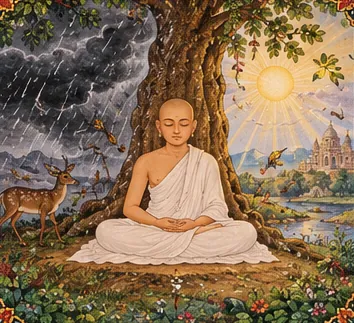
The Elephant and the Hare
In a past life, Megha was a great elephant. One day a forest fire broke out. All the animals crowded into a cleared space. The elephant lifted a foot to scratch himself — and a little hare darted into the gap beneath it.
Out of compassion, the elephant stood on three legs, holding his foot in the air, for two and a half days until the fire died down. When he finally tried to lower it, his leg had stiffened. He fell and died — and that act of mercy, the story says, led to his birth as a prince.
“For a hare you endured that,” said Mahāvīra, “and you cannot bear the dust of monks’ feet?” Megha stayed.
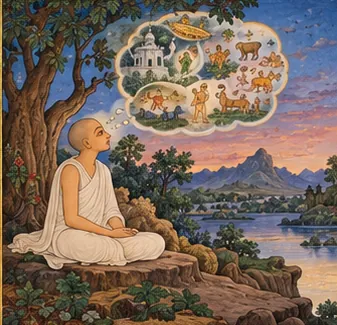
The Two Tortoises
Two tortoises came out of a lake at night, searching for food. Two hungry jackals saw them. Both tortoises pulled their heads and legs into their shells.
The jackals waited. One tortoise grew impatient and stuck out a leg. The jackals tore it out — then the next, and the next.
The other tortoise waited until the jackals had truly gone, then walked safely home. The lesson: a monk who guards the senses, like a tortoise drawing in its limbs, stays safe from the jackals of desire.
Rohiṇī and the Five Grains of Rice
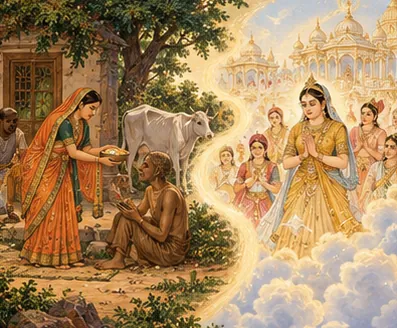
A wealthy merchant wanted to test his four daughters-in-law. He gave each five grains of rice and said, “Keep these. I will ask for them later.”
The first threw them away. The second ate them. The third locked them safely in a box. The fourth, Rohiṇī, sent them to her family’s fields to be planted, harvested and replanted.
Five years later, when he asked, she needed carts to bring back the harvest. The merchant made her mistress of the household. The five grains, monks explain, are the five great vows: throw them away, waste them, merely preserve them — or make them grow.
Mallī, the Nineteenth Tīrthaṅkara
Śvetāmbara tradition tells that the nineteenth Tīrthaṅkara, Mallī, was born a princess. Six kings desired her.
She had a golden statue made in her own likeness, hollow inside, and each day dropped a morsel of food into it. When the kings were brought in, she lifted the lid. A foul smell filled the room.
“This body you desire,” she said, “is like this.” The kings, stirred, remembered their past lives with her and turned toward renunciation.
What it teaches
- Compassion even toward the smallest creature has great power
- Guard your senses as a tortoise guards its limbs
- Vows are meant to grow, not merely to be kept
- Attachment to the body can be questioned with courage
- Stories can carry teachings across generations
How the text is arranged
Two books. The first has nineteen chapters, each built around a story, including Meghakumāra, the tortoises, Rohiṇī, Mallī and Draupadī. The second book is a shorter collection of accounts about goddesses and their past lives.
Five grains, used wisely, can fill a granary.
Ask yourselfWhich of the four daughters-in-law are you with the good gifts you have been given?