Candraprajñapti
The moon’s cycles, the constellations and the count of months — the companion to the Sun book.
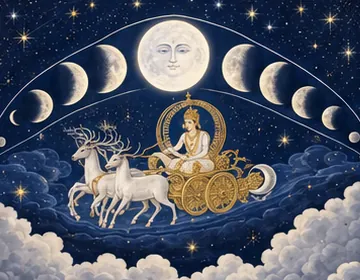
Candra means moon. This text describes the moon’s paths and phases, the 28 constellations (nakṣatras) and the measurement of months. Its content is very close to that of the Sūryaprajñapti.
The story
The Waxing and Waning
The moon grows and shrinks across the month. Jain cosmology explains its movement along fifteen circular paths and its passage through the constellations.
These calculations matter in daily religious life: the Jain calendar of fasts and festivals, like Paryuṣaṇa, follows the moon.
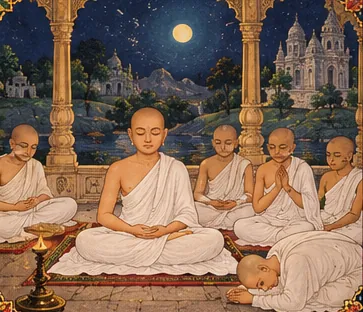
Night and Moon
Jain monks traditionally do not eat after sunset, and many lay Jains follow this too. Night is a time for reflection and rest.
The moon above becomes a quiet companion to meditation — waxing, waning, but always the same moon.
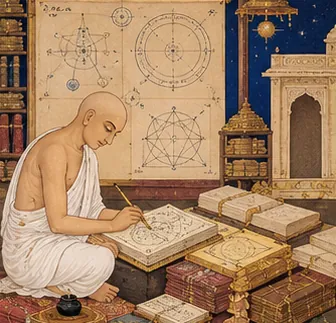
Two Books, One Sky
Why are the Sun and Moon books so similar? Scholars still discuss this. Tradition keeps them as two separate Upāṅgas, one dedicated to each light.
Together, they show how ancient Jains combined careful observation with a sacred view of time.
What it teaches
- The moon moves along fifteen paths in Jain cosmology
- The 28 nakṣatras mark the moon’s journey
- The religious calendar is lunar
- Its content parallels the Sūryaprajñapti
How the text is arranged
Twenty sections (prābhṛtas), closely parallel to the Sūryaprajñapti.
The moon changes its face every night, but never stops being the moon.
Ask yourselfWhat remains steady in you through all your changing phases?