Nirayāvalikā
Ten princes march into a war of ambition — and ten mothers ask Mahāvīra what became of their sons.
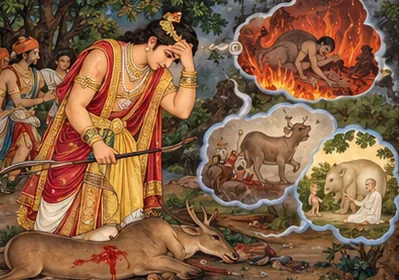
This is the first of five short, connected narrative texts at the end of the Upāṅgas. Nirayāvalikā means “a row (of those who go) to hell.” It is a powerful story about ambition, family conflict and the cost of violence.
The story
A Family Quarrel
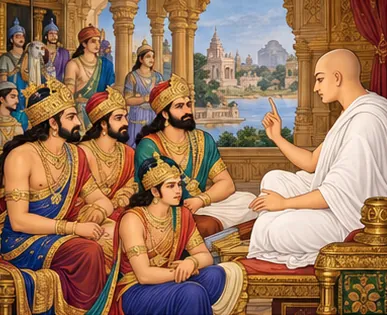
King Śreṇika of Magadha had given his sons Halla and Vihalla a divine necklace and a magnificent elephant. Their brother Kūṇika, now king, wanted them.
The two brothers fled to their grandfather, King Ceṭaka of Vaiśālī. Kūṇika declared war.
Ten of Kūṇika’s half-brothers — Kāla, Sukāla, Mahākāla and others — rode out to fight beside him.
The Great War
The battle was terrible. The text tells that Ceṭaka, a skilled archer who had vowed to shoot only one arrow a day, struck down one of the ten princes each day.
One by one, they fell — all for a necklace and an elephant.
Ten Mothers Ask
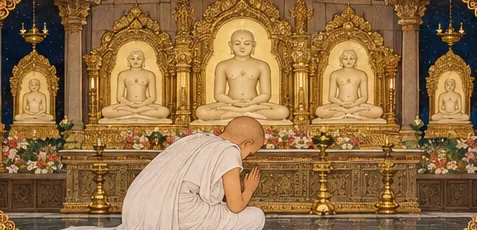
Each prince’s mother, a queen of Śreṇika, went to Mahāvīra: “Will I see my son again?”
Mahāvīra told them gently that their sons had died in violence and had been reborn in hell.
The queens, overwhelmed, renounced the world and became nuns. Their grief became a path.
The Cost of Ambition
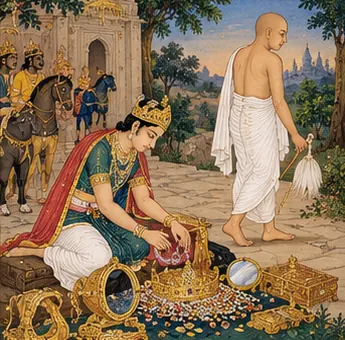
The Nirayāvalikā is short, but it lingers. A precious object, a brother’s jealousy, a king’s pride — and the result is war, death and terrible rebirths.
It asks: is anything you possess worth the violence it takes to hold it?
What it teaches
- Greed and jealousy can lead to violence
- Violence carries heavy karmic consequences
- Grief can become a path to renunciation
- Possessions are never worth harming others
How the text is arranged
Ten chapters, one for each prince who died in the war. It is the first of five connected texts (Nirayāvalikā, Kalpāvataṃsikā, Puṣpikā, Puṣpacūlikā and Vṛṣṇidaśā), sometimes grouped together under the name Nirayāvalikā.
A necklace can be worn for a lifetime; its karma can last far longer.
Ask yourselfWhat do you hold so tightly that it might be causing harm?