Jambūdvīpaprajñapti
A journey across the central continent, the cycles of time, the first Tīrthaṅkara and an emperor’s conquest.
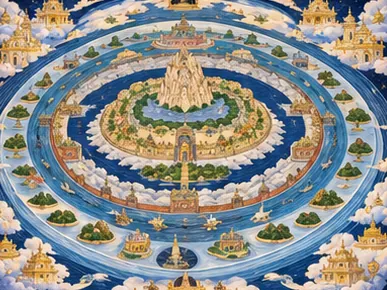
Jambūdvīpa, “the island of the rose-apple tree,” is the central continent of Jain cosmology. This Upāṅga describes its regions, mountains and rivers — and the history that unfolds within it.
The story
The Island at the Centre
Jambūdvīpa is a perfect circle, said to be a hundred thousand yojanas across, with golden Mount Meru at its heart. Mountain ranges divide it into regions, and rivers like the Gaṅgā and Sindhu flow across it.
Our own region, Bharata-kṣetra, lies in the south.
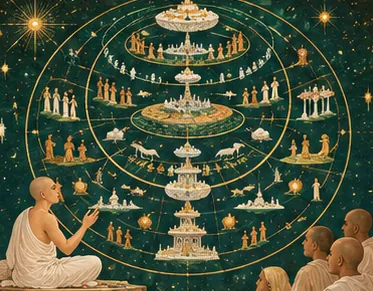
The Wheel of Time
In Bharata, time turns like a wheel with six spokes in a descending half and six in an ascending half. In the earliest ages, people lived in ease, with wish-fulfilling trees. As the ages decline, life grows harder.
At the end of the third age, the text tells, Ṛṣabhadeva appeared — the first king and first Tīrthaṅkara, who taught people farming, writing and crafts, and then the path to liberation.
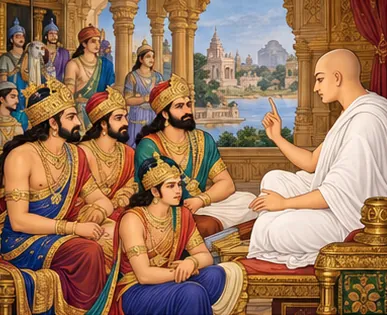
The Emperor Bharata
Ṛṣabha’s son Bharata became the first Cakravartin, a world emperor. The text follows his great campaign of conquest across the six regions of Bharata-kṣetra, guided by a divine wheel-jewel.
Yet tradition remembers that this greatest of conquerors finally renounced everything — and reached liberation.
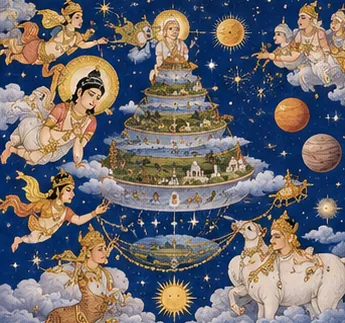
Gods on Mount Meru
The book also describes how, when a Tīrthaṅkara is born, the Indras carry the infant to the summit of Meru for a celestial bathing ceremony. Temple rituals today echo this moment.
So a geography book becomes a story of sacred time and sacred space.
What it teaches
- Jambūdvīpa is the central continent of Jain cosmology
- Time moves in great rising and falling cycles
- Ṛṣabhadeva taught civilisation and the path
- Even an emperor can renounce the world
How the text is arranged
Seven sections (vakṣaskāras) on Bharata-kṣetra, the time cycle, Ṛṣabha and Bharata, mountains and regions, the birth ceremony of Tīrthaṅkaras, and astronomy.
The emperor who conquered six regions still had one kingdom left to win — his own mind.
Ask yourselfWhat “conquest” in your life might be worth giving up?