Devendrastava
A devotee’s wife asks about the Indras of heaven — and the answer tours the whole celestial world.
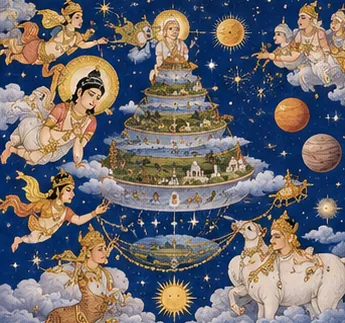
Devendra means lord of the gods (Indra). Stava means praise. This text describes the many Indras of Jain cosmology — and shows them all bowing before the Jina.
The story
A Question at Dawn
A devoted layman is reciting praise of Mahāvīra in the early morning. His wife asks: you speak of Indras who honour the Lord — who are they?
And he describes them: thirty-two lords of the gods, ruling different celestial realms.
A Tour of Heaven
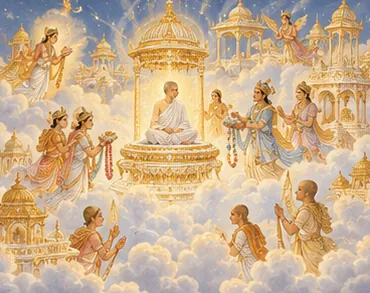
The text tours their worlds — their palaces, splendour, lifespans and retinues.
It is dazzling. And yet, all these gods bow to a human being who has conquered himself.
The Lesson
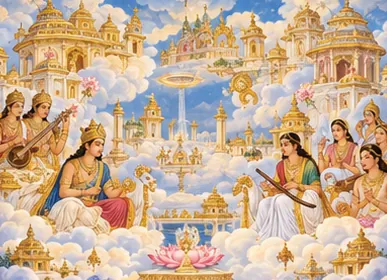
Gods may be powerful and happy, but they are not free. A Tīrthaṅkara is free.
That is why, in Jain art, the Indras serve the Jina — and why devotion is directed not at power, but at liberation.
What it teaches
- Jain cosmology has many Indras
- Even gods honour the Jina
- Freedom is higher than power or pleasure
How the text is arranged
A Prakīrṇaka of about 300 verses, framed as a dialogue between a lay devotee and his wife, describing the Indras and their realms.
The kings of heaven bow to the one who rules himself.
Ask yourselfWhat do you honour more — power, or freedom?