Sūryaprajñapti
An ancient astronomy of two suns, circling orbits and the measurement of time.
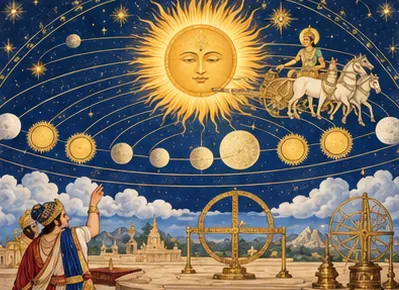
Sūrya means sun; prajñapti means exposition. This text describes the movement of the sun and other heavenly bodies within the Jain picture of the universe. It is an important source for the history of early Indian astronomy.
The story
Two Suns Over Jambūdvīpa
In Jain cosmology, the middle continent Jambūdvīpa has not one sun but two, and two moons. They circle around the great central mountain, Meru.
When one sun lights one side, the other lights the opposite side. Day and night are explained by their slow circling around the mountain.
Paths Across the Sky
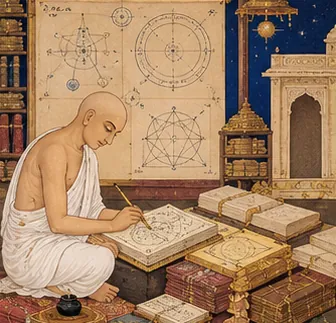
The text describes many circular paths (maṇḍalas) along which the sun moves through the year — closer to Meru in one season, farther in another, making days long or short.
It calculates lengths of days, months and years, the movements of constellations, and the cycles of time.
Reading It Today
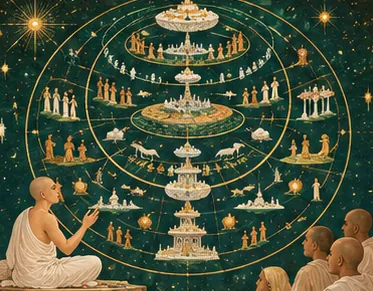
This is traditional cosmology, not a modern science textbook. Its value lies in showing how carefully ancient thinkers observed and calculated, and how they joined the sky to their spiritual worldview.
Time, for Jains, is real and endless. Measuring the sun is a way of measuring the vastness of the soul’s journey.
What it teaches
- Jain cosmology describes two suns and two moons in Jambūdvīpa
- The sun moves along many circular paths
- Days, months and years are carefully calculated
- It is a key source for early Indian astronomy
How the text is arranged
Twenty sections (prābhṛtas). Its content closely parallels the Candraprajñapti; the two are often studied together.
Every sunrise is a measure of time the soul has been given.
Ask yourselfIf you measured your day by its sunrise and sunset, what would you do differently?