Upāsakadaśāṅga
Ten householders — merchants, a potter, a farmer — who lived with vows while running homes and businesses.
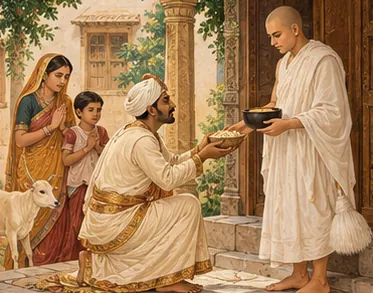
Upāsaka means a lay follower — someone who “sits near” the teaching while living a family life. Daśā means ten.
This seventh Aṅga tells the stories of ten wealthy householders who took the twelve lay vows from Mahāvīra and kept them through business, family pressures and even terrifying tests.
The story
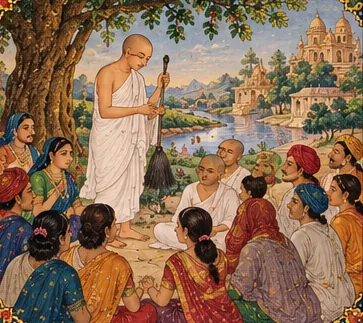
Ānanda Takes the Twelve Vows
Ānanda was a rich merchant of Vāṇijagrāma, with lands, herds and great wealth. When he heard Mahāvīra, he did not become a monk. Instead, he took the twelve vows of a householder.
He limited his violence, his lies, his possessions, even the number of cows and fields he would keep. He set limits on what he would eat, wear and use.
It is the earliest detailed description of a Jain householder’s vows — the blueprint for lay life still followed today.
When Gautama Apologised
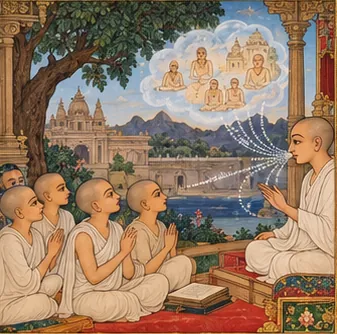
Years later, Ānanda attained a special clairvoyant knowledge. When Gautama visited him, Ānanda described how far he could see. Gautama said, “A householder cannot see that far. You must atone for this false claim.”
Gautama asked Mahāvīra — and learned that Ānanda was right.
So Gautama, the chief disciple, walked back to the householder’s house to ask his forgiveness. Truth, the story teaches, is greater than rank.

Kāmadeva and the Terrifying Test
Kāmadeva was meditating one night when a celestial being decided to test him. It appeared as a monstrous demon with a sword: “Give up your vows, or I will cut you to pieces!” Kāmadeva did not move.
It became a mad elephant, then a deadly serpent. Still he sat, calm and unbroken.
At last the being bowed before him and left. Next day, Mahāvīra praised Kāmadeva to the monks: if a householder can be this steady, how much more should you be?
The Potter and the Question of Fate
Saddālaputra was a potter who followed Gośāla’s teaching that everything is fixed by destiny.
Mahāvīra visited him and asked, “If someone smashed your pots, or insulted your wife — would you punish them?” “Of course!” said the potter.
“But if everything is destiny, why punish? They could not help it.” Saddālaputra saw the flaw. Effort and responsibility are real. He became a follower of Mahāvīra.
What it teaches
- Householders can follow a serious spiritual path
- The twelve lay vows set limits on harm and possession
- Truth matters more than position
- Steadiness in vows can face any test
- Effort and responsibility are real, not fate
How the text is arranged
Ten chapters, each telling the life of one lay disciple: Ānanda, Kāmadeva, Culanīpitā, Surādeva, Cullaśataka, Kuṇḍakolika, Saddālaputra, Mahāśataka, Nandinīpitā and Sālihīpitā.
The temple of the vows can stand in the middle of the marketplace.
Ask yourselfWhat one limit could you set in your daily life that would make it gentler?