Nandī Sūtra
The five kinds of knowledge, fourteen kinds of listeners — and the clever village boy Rohaka.
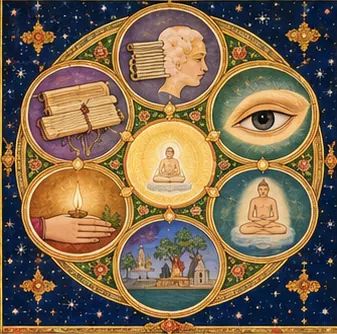
Nandī means joy or an auspicious beginning. This text opens the study of scripture. Tradition attributes it to Devavācaka. It explains the five kinds of knowledge and lists the whole body of sacred texts.
The story
An Auspicious Beginning
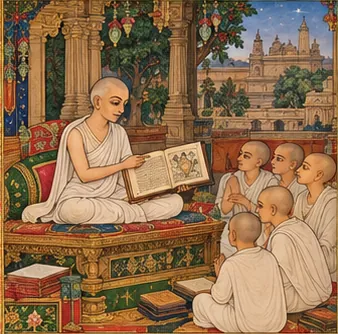
The Nandī begins with praise: of Mahāvīra, of the community, of the teachers who carried the tradition. Then it lists the lineage of elders — a family tree of knowledge.
Before learning, it says, honour those who made learning possible.

What Kind of Listener Are You?
The Nandī compares listeners to many things. Some are like a rock in the rain — the water runs off. Some are like a pot with a crack — knowledge leaks out. Some are like a sieve.
And some are like a swan, which, in old Indian lore, can separate milk from water — taking the good and leaving the rest. Which are you?
The Five Kinds of Knowledge
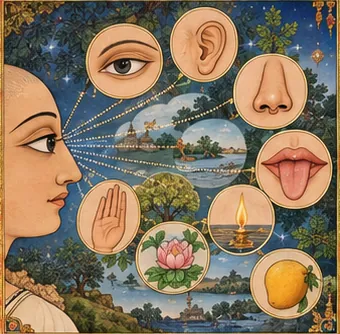
Jain thought describes five knowledges. Mati — knowledge through senses and mind. Śruta — knowledge through words and scripture. Avadhi — clairvoyant knowledge of distant forms. Manaḥparyāya — knowing the thoughts of others. Kevala — perfect, omniscient knowledge.

Seeing Beyond the Senses
The first two are common. The next two are rare, arising through spiritual purification. The last is the knowledge of the Jinas.
The Nandī treats knowledge as a ladder: each rung clears away a little more of the karmic cloud that hides the soul’s natural light.
Rohaka the Clever Boy
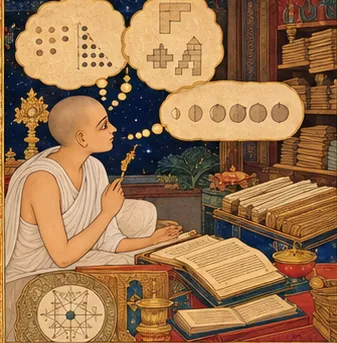
The Nandī also describes kinds of natural intelligence, with lively stories. The most famous is Rohaka, a village boy who solved a king’s impossible challenges.
Ordered to build a pavilion over a huge rock without moving it, the villagers despaired. Rohaka simply told them to dig beneath it and build supports around it. The rock became the roof.
Wisdom, says the story, can appear anywhere — even in a child from a small village.
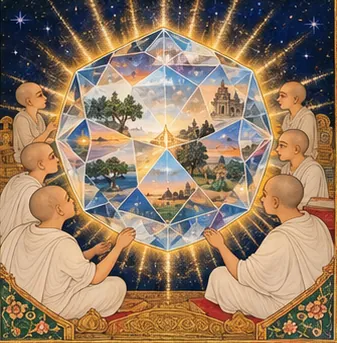
The Light Within
The final knowledge, kevala-jñāna, is not added from outside. It is the soul’s own nature, uncovered.
Like the sun behind clouds, it was always shining.
What it teaches
- Honour the lineage of teachers before learning
- Be a listener like a swan, not like a rock
- Five kinds of knowledge, from senses to omniscience
- Intelligence can be found anywhere
How the text is arranged
An introductory text with praise, the lineage of elders, kinds of listeners, the five knowledges, kinds of intelligence and a catalogue of scriptures.
The sun of knowledge is already inside you. Learning only clears the clouds.
Ask yourselfWhat kind of listener were you in your last important conversation?