Sthānāṅga
A treasure chest arranged by numbers — from the one soul to the ten wonders that astonished the world.

Sthāna means place or position. In this third Aṅga, each idea is given its “place” in a numbered group: things that come in ones, in twos, in threes — all the way to tens.
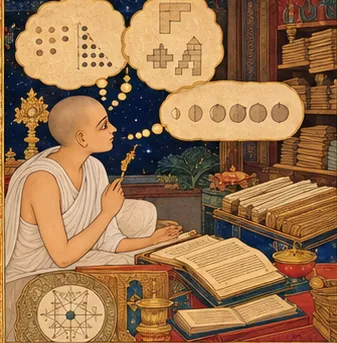
It is a memory palace. For monks who carried the scriptures in their heads, numbers were shelves on which knowledge could be stored and found again.
The story
A Library with Ten Shelves
Imagine a library with ten shelves. On the first shelf: things that are one. The text begins boldly — “the soul is one.” Not because there is only one soul, but because, in its essential nature, every soul is the same pure consciousness.
On the second shelf: pairs. Living and non-living. Bondage and liberation. On the third: triads, like the three jewels of right faith, right knowledge and right conduct.
Shelf by shelf, the whole world of Jain thought is placed in order.
Four Kinds of Clouds
The Sthānāṅga loves fourfold comparisons. One famous set speaks of clouds. Some thunder and rain. Some thunder but never rain. Some rain without thunder. Some do neither.
People are like that too. Some speak and act. Some only speak. Some quietly act. Some do nothing at all.
With images like these, a dry list becomes a mirror. You read a classification and suddenly ask: which cloud am I?

The Ten Wonders
On the tenth shelf the text records ten “wonders” (āścaryas) — events that the tradition says are extremely rare in the history of the world.
Among them: the transfer of Mahāvīra’s embryo from one mother to another; the Tīrthaṅkara Mallī being born a woman, according to Śvetāmbara tradition; and a first sermon of Mahāvīra after which no one took vows.
These wonders remind the reader that even a well-ordered cosmos holds surprises.
Why Lists Can Be Beautiful
To a modern reader, a numbered list may seem dull. To an ancient monk, it was a lifeline.
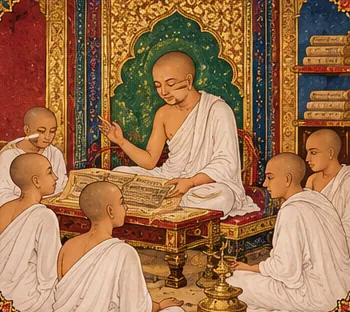
A list can be chanted. A list can be checked. If you forget the seventh item of a group of ten, your fellow monks will notice. In this way, the Sthānāṅga helped protect vast knowledge through centuries without paper.
And for us, each list is a doorway: open any item, and a whole teaching waits behind it.
What it teaches
- Knowledge is organised into groups from one to ten
- The soul is “one” in its essential nature
- Comparisons — like the four clouds — turn lists into self-reflection
- Rare events are recorded as the ten wonders
- Numbered lists were tools for oral memory
How the text is arranged
Ten chapters called sthānas, one for each number from one to ten. Each chapter gathers doctrines, cosmology, ethics, history and people that fit its number. It is usually read with later commentaries, such as Abhayadeva Sūri’s.
Give every truth a place, and you will find it again when you need it.
Ask yourselfOf the four kinds of clouds, which do you most want to be?