Taṇḍulavaicārika
How many grains of rice will you eat in a lifetime? A startling meditation on the human body and its ten stages.
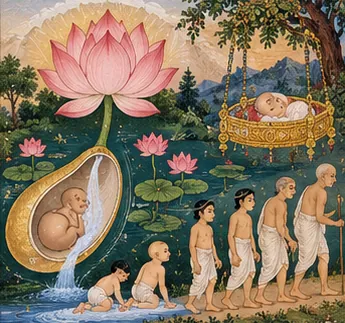
Taṇḍula means a grain of rice. Vaicārika means reflection. This unusual text reflects on the human body — from the womb to old age — to cut through vanity and attachment. Its descriptions are traditional, not modern medicine.
The story
The Mountain of Rice
The text calculates how much rice a person eats in a hundred years. The answer is a mountain of grain.
All that — for a body that will still grow old and die. The calculation is a jolt: look at how much life consumes, and ask what it gives back.
Ten Stages of a Life
It divides a hundred-year life into ten decades: childhood, play, slowness of understanding, strength, wisdom, decline, slackening, bending, failing speech and lying down.
Each decade has its own character — like ten seasons of a single year.
Why Think About the Body?
It also describes, in traditional terms, the development of the body in the womb. The aim is not science, but detachment: to see the body as a temporary home, not the soul’s true self.
From the mountain of rice to the ten decades, the message is: use this body to free the soul.
What it teaches
- A lifetime consumes a mountain of resources
- A hundred-year life has ten stages
- Reflection on the body loosens attachment
- Its descriptions are traditional, not modern science
How the text is arranged
A Prakīrṇaka in verse and prose on embryology, the ten life stages and the impermanence of the body.
A mountain of rice goes into a single life. Let something good come out of it.
Ask yourselfWhich decade of life are you in — and what is its gift?